
Hollowing in Pentagonal Particles: Grain Boundary Diffusion Model
Abstract
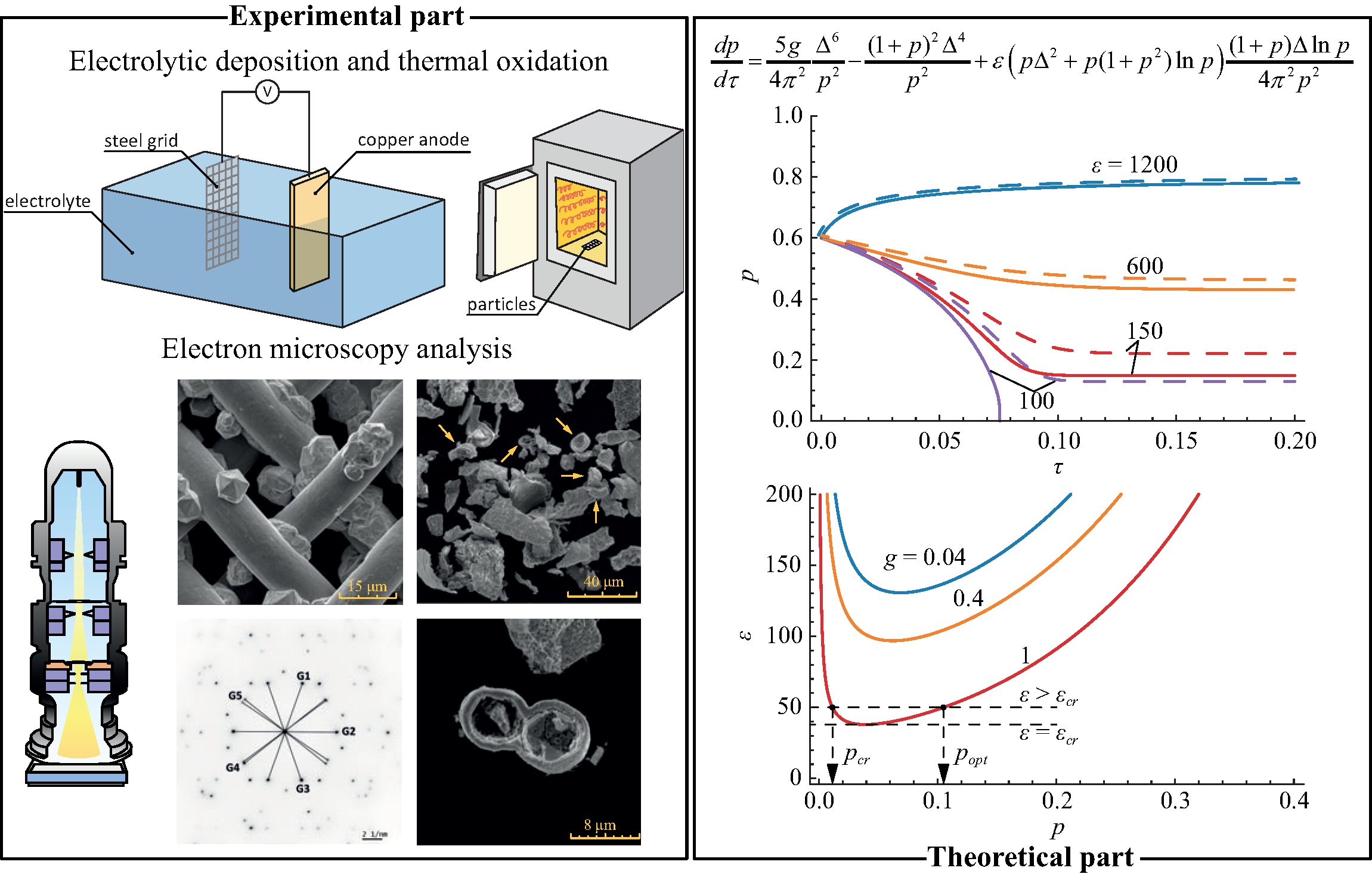
An analytical model of pore nucleation via grain-boundary diffusion of vacancies in pentagonal crystals has been proposed. According to this model, the vacancy fluxes along the twin boundaries make the major contribution to the void formation process. The void evolution equation has been derived from the difference in chemical potentials at the inner and outer surfaces determined within the energy approach, taking into account the surface energy of free surfaces and twin boundaries as well as the strain energy of the disclination. The model predicts the existence of critical and optimal void sizes and reveals the conditions under which voids grow, stabilize, or shrink until complete dissolution. In addition, we report on the stress-induced formation of a central pore in initially solid Cu pentagonal particles as a promising way to fabricate hollow structures.
Keywords
Pentagonal crystals; Multiply twinned particles; Pore; Disclination; Grain boundary diffusionFundings
Russian Science Foundation: grant No. 23-72-10014-P


This is an open access article under the terms
of the CC BY-NC 4.0 license.
Metadata is available under the terms of the CC BY 4.0 license